A safe, progressive method to configure SPF, DKIM and DMARC without blocking legitimate business email. The objective is simple: inventory senders, clean SPF, enable DKIM, observe DMARC, then enforce gradually, without breaking legitimate business email. This guide favors a cautious, documented and measurable method for SMBs, IT teams, marketing owners and executives.
Direct answer: identify real sending flows, check DNS records, apply fixes one by one, test toward Gmail and Outlook, then observe results before enforcement. For this topic, the guiding principle is to inventory senders, clean SPF, enable DKIM, observe DMARC, then enforce gradually.
Key takeaway: Do not change a critical DNS record before understanding which tool uses it. A technically correct fix can interrupt invoices, notifications, web forms or campaigns when the flow was not inventoried.
In short
- A good diagnosis starts with real flows, not assumptions.
- DNS changes should be dated, tested and reversible.
- Gmail and Outlook react to technical setup, but also to reputation and engagement.
- A progressive method protects deliverability and business workflows.
Diagram: how SPF, DKIM and DMARC checks happen
Before changing DNS records, understand where SPF, DKIM and DMARC intervene in the email delivery path.
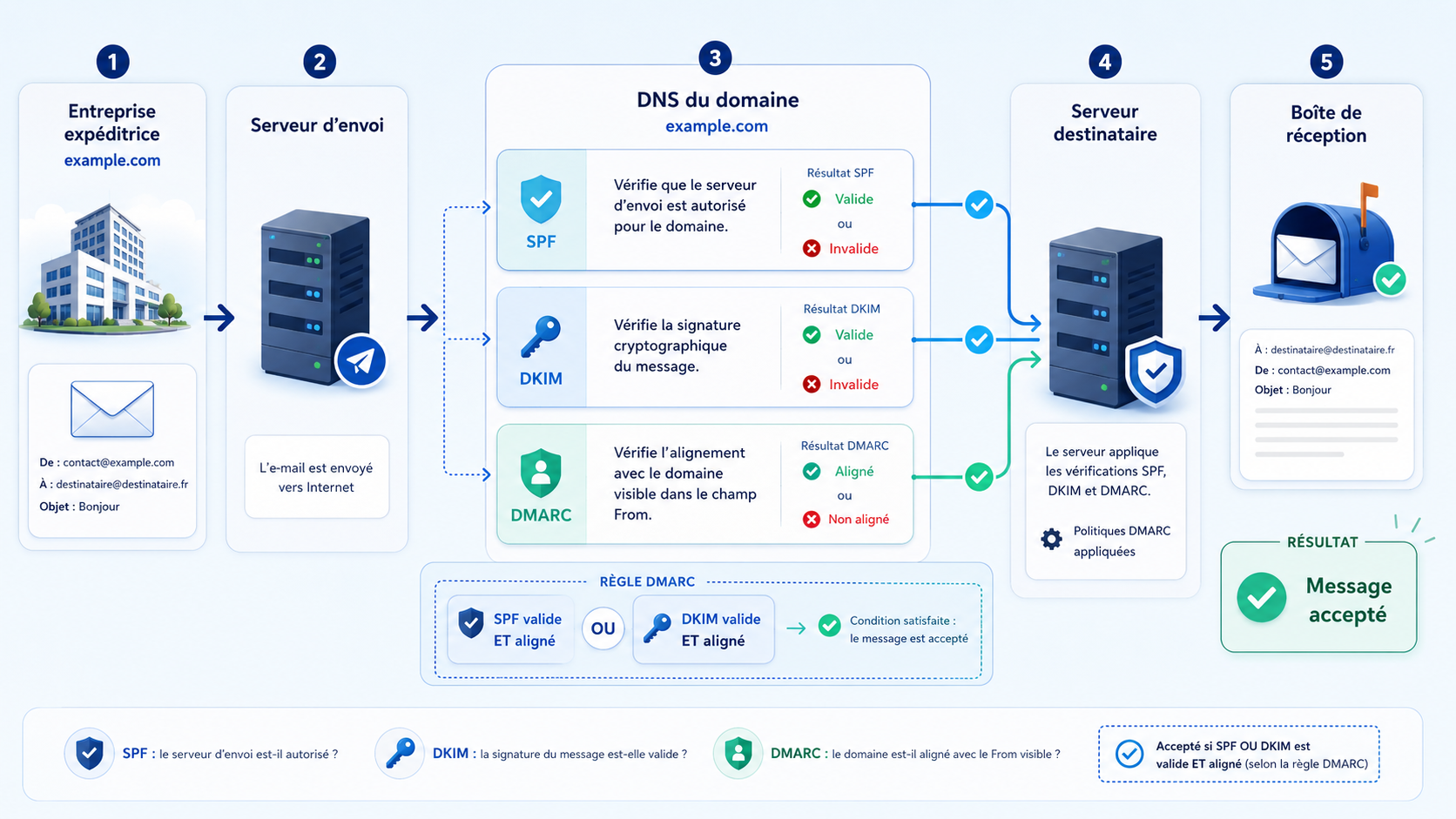
Simplified email journey: the receiving server checks SPF, DKIM and DMARC before accepting or filtering the message.
DMARC does not require both SPF and DKIM to pass. A message can pass DMARC when SPF is valid and aligned, or when DKIM is valid and aligned.
Diagram: inventory legitimate senders
A safe configuration starts with a sender map, not with a DNS record copied too quickly.
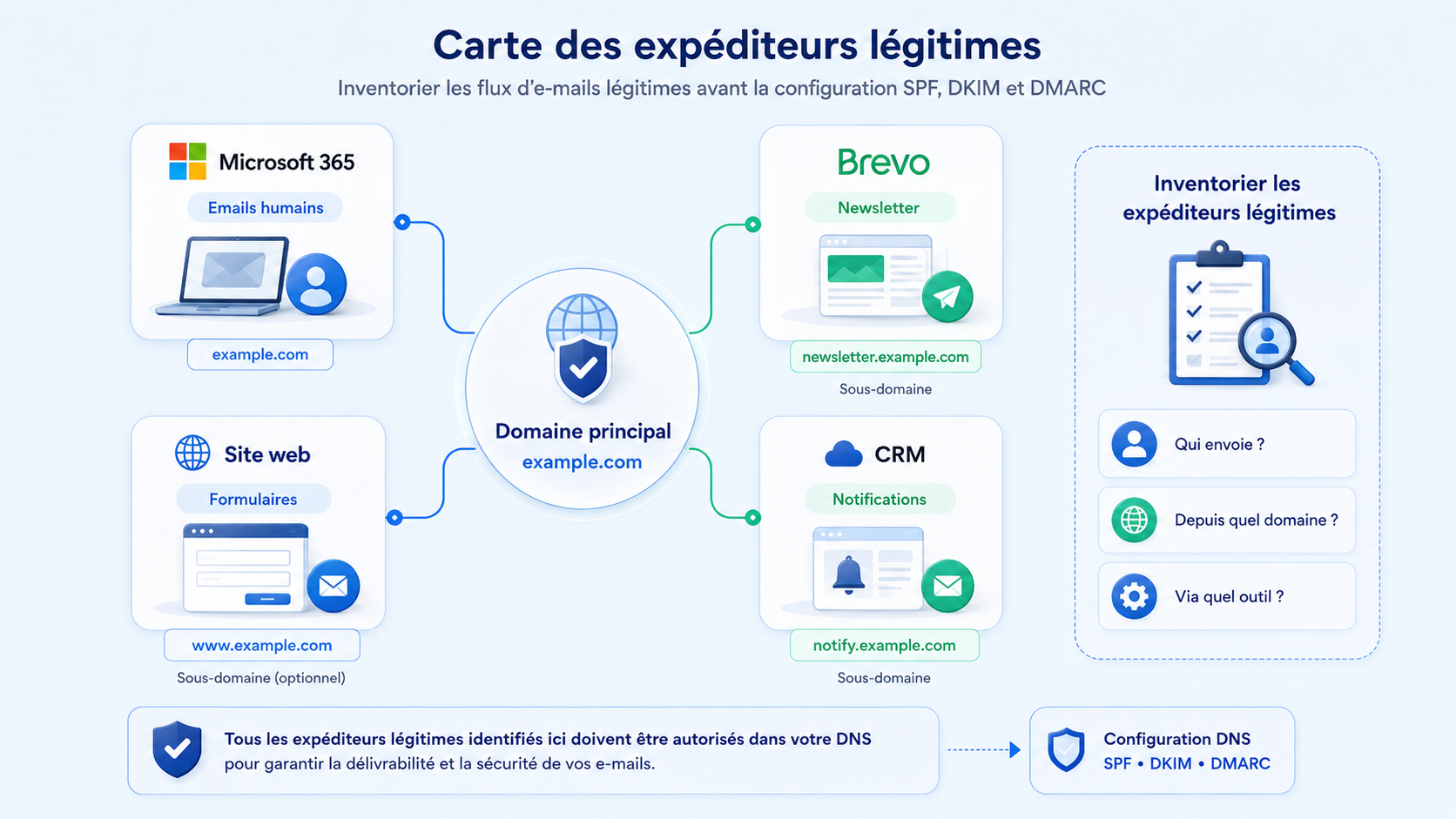
Before enforcing DMARC, identify every tool allowed to send email for the domain or its subdomains.
This prevents breaking a web form, newsletter, CRM or invoicing tool. Every flow needs an owner, a sending domain and an authentication method.
Diagram: enforce DMARC progressively
DMARC should be deployed in stages, following report quality and business-flow remediation.
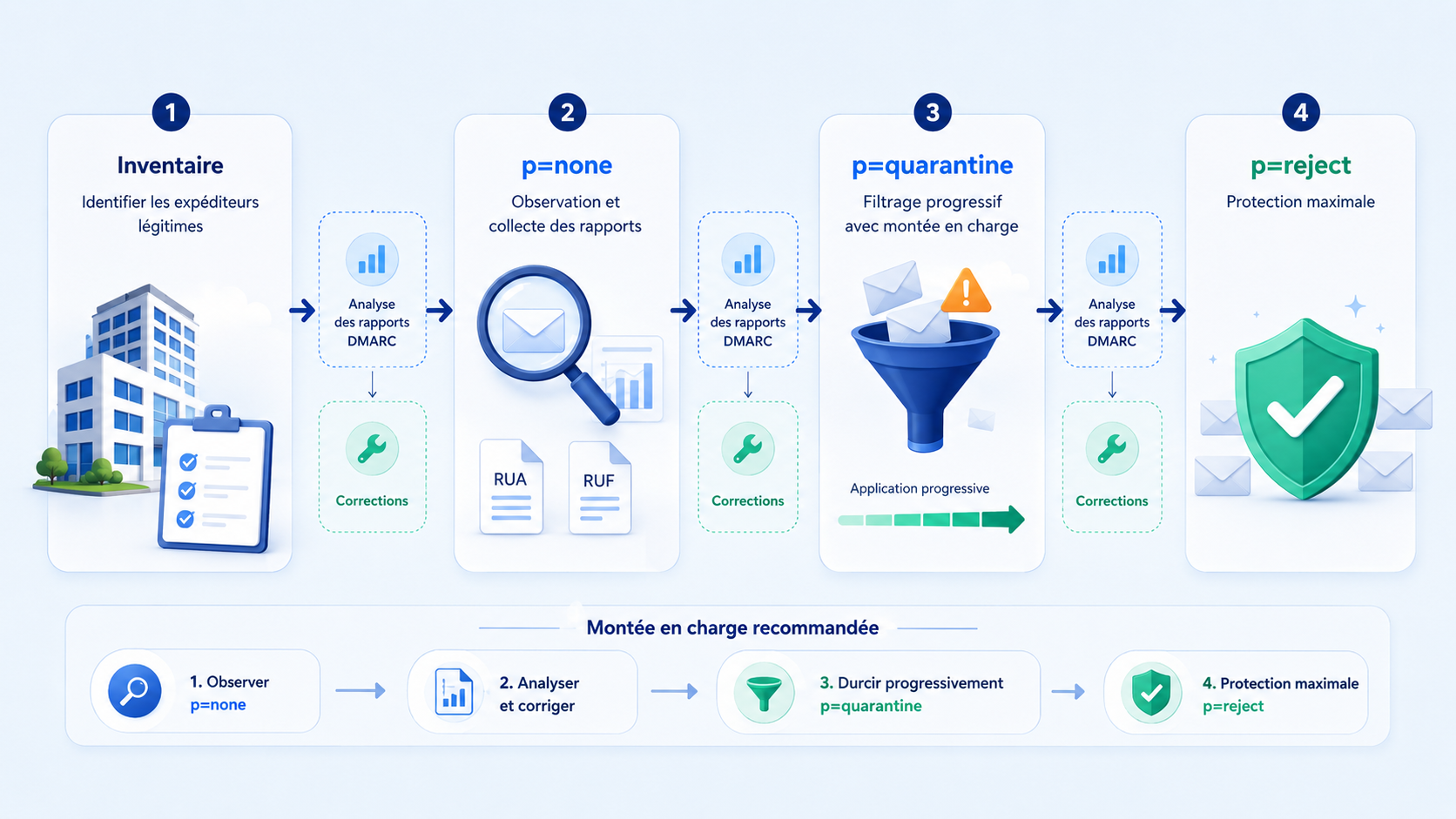
A DMARC policy is tightened gradually: monitoring, report analysis, remediation and stronger protection.
Moving to p=quarantine or p=reject should be a diagnostic outcome, not an isolated target. DMARC reports prove that legitimate flows are ready.
Diagram: understand DMARC alignment
Alignment is what turns SPF and DKIM into protection for the domain visible to the recipient.
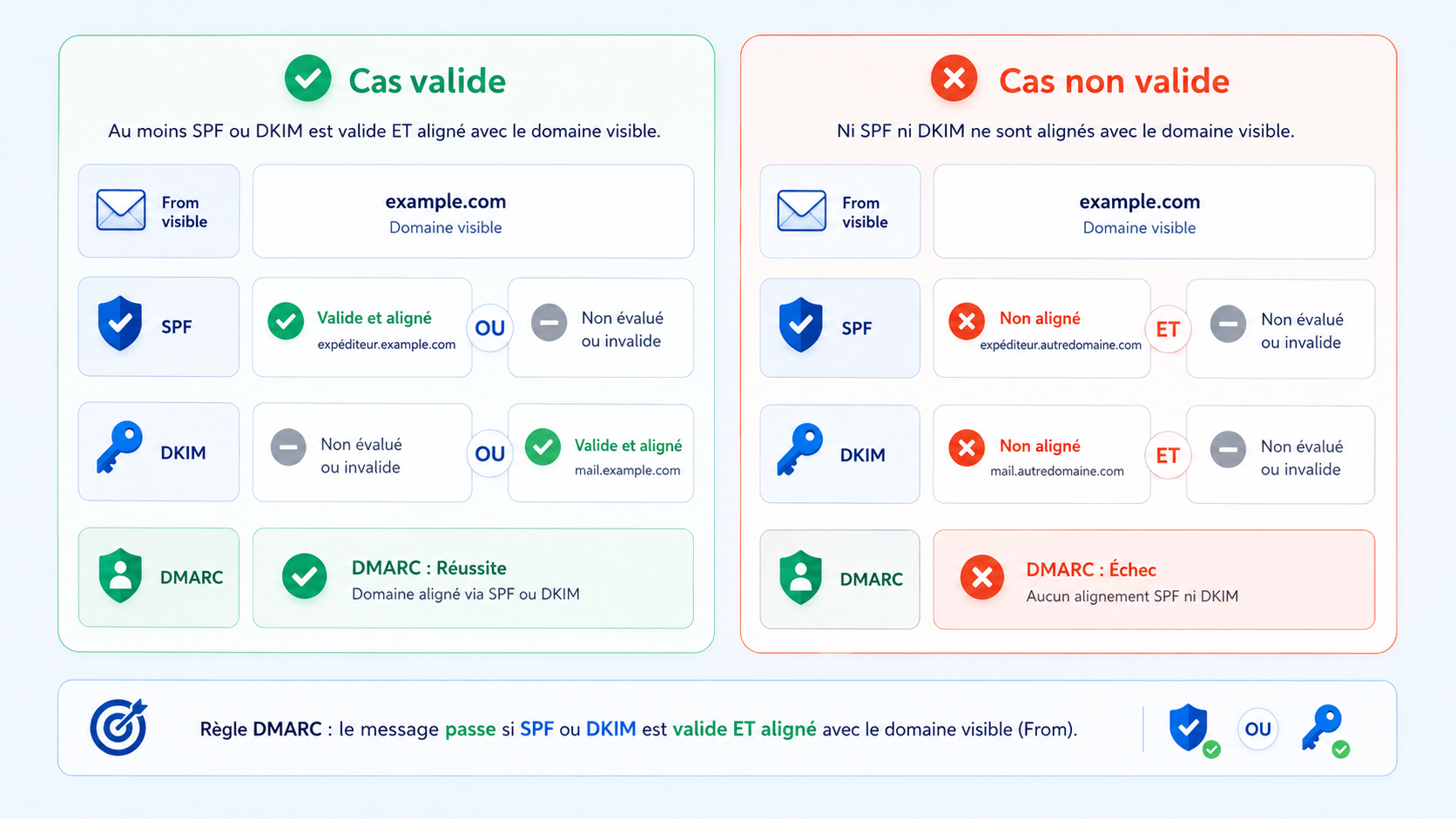
DMARC passes when SPF or DKIM is valid and aligned with the domain visible in the From header.
A technically valid SPF result can still fail DMARC when the authenticated domain is not aligned with the visible From domain. Marketing platforms and CRMs often need adjustment here.
When should you use this method?
Use this method when the domain sends from several platforms, when deliverability drops, or before enforcing a stricter DMARC policy. It is also useful after a Microsoft 365, Google Workspace, CRM or marketing platform migration.
It also applies to organizations that want to strengthen email authentication before a customer audit, DNS migration, platform change or major campaign.
Step-by-step procedure
| Step | Action | Validation |
|---|---|---|
| 1 | Map real sending flows, including website, CRM, invoicing, support, marketing and collaboration mailbox. | Documented check |
| 2 | Check DNS records before changing them and keep a dated copy of the initial state. | Documented check |
| 3 | Apply the fix on a limited scope with a clear observation window. | Documented check |
| 4 | Test critical messages toward Gmail, Outlook and a neutral external mailbox. | Documented check |
| 5 | Compare technical results with business feedback: inboxing, spam, promotions, rejections and bounces. | Documented check |
| 6 | Document the decision, tool owners and next review date. | Documented check |
Concrete DNS example
Always adapt values to the real provider. Never copy a DNS example without checking the domain, DKIM selector, report address and expected policy.
example.com. TXT "v=spf1 include:spf.protection.outlook.com include:example-esp.net -all"
selector1._domainkey.example.com. CNAME selector1-example-com._domainkey.provider.example.
_dmarc.example.com. TXT "v=DMARC1; p=none; rua=mailto:dmarc@example.com; adkim=s; aspf=s"
Business deliverability precautions
Do not change a critical DNS record before understanding which tool uses it. A technically correct fix can interrupt invoices, notifications, web forms or campaigns when the flow was not inventoried.
Deliverability does not depend only on SPF, DKIM or DMARC. Complaints, bounces, list quality, volume, campaign consistency and content clarity also matter. Connect this tutorial with audit and deliverability services.
Short definitions
- SPF : DNS record that authorizes servers to send for a domain.
- DKIM : cryptographic signature proving message integrity.
- DMARC : policy that checks alignment and requests an action on failure.
- Sending domain : visible or technical domain used by a platform to send.
- Domain reputation : trust level built by providers from sending history.
Useful internal links
- Dharmail
- audit and deliverability services
- Dharmail blog
- How to Read a DMARC XML Report and Identify Who Sends Email From Your Domain
- How to Create a Sending Subdomain for Brevo, ActiveCampaign or Mailjet
- Why Do My Emails Land in Spam or Gmail Promotions?
- How to Set Up and Use Google Postmaster Tools to Monitor Email Reputation
Final checklist
- Map real sending flows, including website, CRM, invoicing, support, marketing and collaboration mailbox.
- Check DNS records before changing them and keep a dated copy of the initial state.
- Apply the fix on a limited scope with a clear observation window.
- Test critical messages toward Gmail, Outlook and a neutral external mailbox.
- Compare technical results with business feedback: inboxing, spam, promotions, rejections and bounces.
- Document the decision, tool owners and next review date.
- Monitor results for several days.
- Document the date, owner and reason for every change.
Operational validation method
After every change, create a short control sheet. Record the domain, the modified tool, the DNS record, the change time, the expected result and the person responsible. This avoids confused troubleshooting when several teams work on the same DNS zone or sending platform.
Then send three types of messages: a human email from the primary mailbox, an application message from the website or CRM, and a marketing message if a campaign platform is involved. Check the full received headers, not only the inbox placement. SPF, DKIM and DMARC lines show whether the message passes technically and whether the visible domain remains aligned.
Finally, monitor business signals. Lower replies, higher bounces, unusual complaints or customer feedback should be compared with the change date. This simple discipline helps you fix issues quickly without changing too many variables at once. For an SMB, it is often the difference between controlled improvement and a confusing series of tests.
Use the same review rhythm for the following two weeks. Check whether the same providers keep passing authentication, whether complaint signals remain stable, and whether business teams report fewer placement issues. If a new tool appears, do not add it blindly to SPF. First confirm the owner, sending purpose, DKIM support, visible From domain and expected volume. This keeps the setup understandable for future audits.
When the domain is used by sales, finance or customer support, schedule the change outside peak business hours and inform the people who receive customer replies. Their feedback is often the fastest way to spot a legitimate flow that technical dashboards did not reveal.
FAQ
How long should monitoring last before enforcement?
For an SMB, two to four weeks often provide a useful baseline. The window should include campaigns, invoices, reminders, notifications and rarely used tools.
Can everything be fixed in DNS?
No. DNS exposes authorization and authentication, but it does not replace configuration inside Microsoft 365, Google Workspace, the CRM or the marketing platform.
What is the main risk?
The main risk is blocking a legitimate flow nobody inventoried: invoice, web form, business application or old SMTP relay.
Should marketing flows be separated?
Yes when volume, audience or objective differs from human business email. A subdomain makes diagnostics clearer.
Is one isolated test enough?
No. Mailbox providers use aggregated signals. Observe several days and several message types.
When should I request an audit?
When the domain is business-critical, several tools send email, or deliverability loss affects revenue or customer relationships.
Conclusion
Dharmail can help audit your flows, fix DNS records and monitor the impact on Gmail, Outlook and business tools. Contact Dharmail to turn this tutorial into a domain-specific action plan.